

28 Oct How Roll-to-Roll Manufacturing Is Changing the Future of Leather Alternatives
Many next-generation leather alternatives look impressive as samples but struggle when a brand asks for thousands of metres. The difference between a promising material and a usable one is often the manufacturing process. That is why roll-to-roll production is becoming central to the future of leather alternatives.
What is roll-to-roll manufacturing?
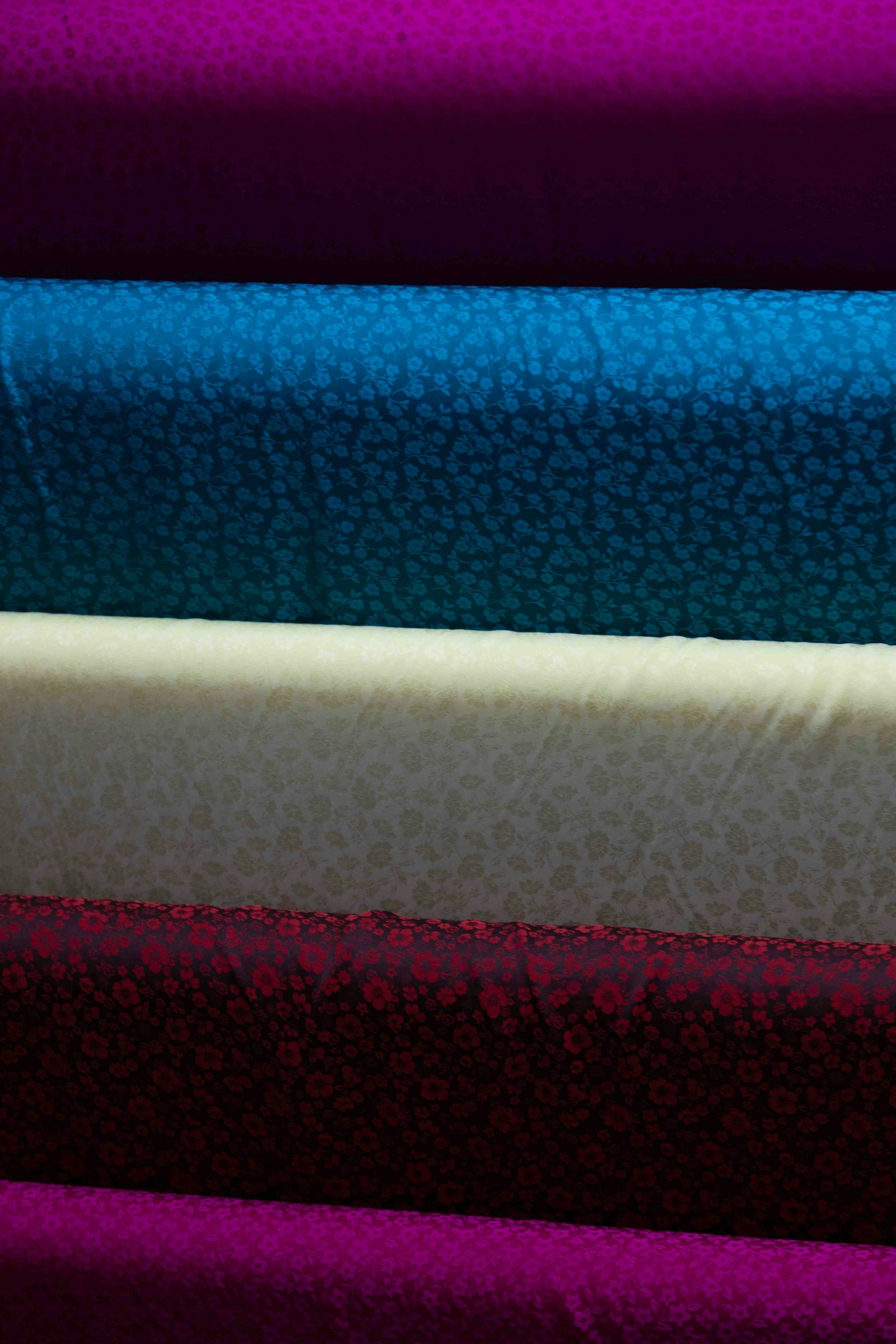
In roll-to-roll (R2R) manufacturing, material is produced as a continuous web that moves from one roll, through a series of process stations, onto another roll. For coated materials such as leather alternatives, a typical line includes:
- Coating the compound onto a release paper or directly onto a fabric (transfer coating uses release paper, which also gives the surface its grain);
- Laminating the textile backing;
- Curing or drying in controlled ovens;
- Finishing with top coats and embossing;
- Inspection and winding into finished rolls.
The same principle is used to make coated fabrics, labels, packaging films and printed electronics.
Why it matters for leather alternatives
1. Consistency
Animal hides vary in size, thickness and surface defects. Batch-cast materials can vary from sheet to sheet. A continuous process holds thickness, colour and surface finish steady along the whole roll, which brands need for colour matching and quality control.
2. Less cutting waste
Uniform rolls of known width let manufacturers nest patterns efficiently with automated cutting. Hides, with their irregular shapes and flaws, typically produce much more offcut waste.
3. Drop-in compatibility
Factories already handle rolled materials (textiles, PU and PVC). A leather alternative supplied in rolls can go straight onto existing cutting tables, CNC cutters and sewing lines without retooling. That lowers the cost and risk of switching.
4. Scale and cost
Continuous production spreads fixed costs over far more metres than batch methods. As volume grows, unit cost falls, which is essential if plant-based materials are to compete with conventional synthetics on price.
5. Customisation without chaos
Changing release paper changes the grain; changing the formulation changes colour; changing the backing changes strength and stretch. R2R lines let producers offer many variants on a single proven platform.
Challenges to solve
Roll-to-roll is not automatic success. Bio-based compounds behave differently from conventional PU: viscosity, curing behaviour and adhesion to the backing all need careful development. Feedstock preparation must be consistent so the fibre content does not cause coating defects. And lines need proper inspection to catch defects before rolls ship.
How Terratan uses roll-to-roll
Terratan™ is produced by transfer coating in a roll-to-roll process. Fine microfibres from agricultural residue are combined with bio resins, natural binders and pigments, coated, laminated to a textile backing, cured and finished. The result is a consistent roll that integrates with existing production lines. Standard material is available at 1.2 mm, with custom thicknesses from 0.6 to 1.5 mm.
Want the bigger picture? Read why scalable roll-to-roll manufacturing is the future of plant-based materials.
Work with Terratan
Terratan™ is Bharat Biomaterials’ plant-based leather alternative, made from agricultural residue and produced in continuous rolls in India. Explore the material, read about our sustainability approach, or contact our team to request the technical data sheet and samples.

Sorry, the comment form is closed at this time.