

28 Oct Can Agro-Waste Be a Valuable Industrial Material? The Rise of Biomass Innovation
Every harvest produces two things: the crop people want, and a much larger pile of what is left behind. Straw, husks, stalks, leaves and bagasse are generated in enormous quantities every season. For decades much of it has been treated as a disposal problem. Increasingly, it is being recognised as a resource.
The problem with crop residue
In many farming regions there is a short window between harvesting one crop and sowing the next. Clearing residue by hand or machine costs money, so burning it in the field is often the cheapest option. In north India, stubble burning after the paddy harvest is linked to seasonal spikes in air pollution across the region. Residue left to rot releases its carbon too, and wastes material that could have been used.
Why agro-waste is a good industrial feedstock
- Volume: residues are produced every season wherever crops are grown, so supply can scale.
- No competition with food: the edible crop has already been harvested; residues are what is left.
- Useful structure: plant residues are lignocellulosic. They are made of cellulose fibres, hemicellulose and lignin, nature’s own composite, which gives them strength and texture.
- Low cost: residue is a by-product, and buying it creates extra income for farmers.
- Climate logic: using residue that would be burned avoids those emissions and keeps carbon locked in useful products for longer.
Where biomass is already being used
Agricultural residues already feed a growing range of industries: bioenergy and biogas, moulded-fibre packaging and tableware, particle boards and building panels, bio-based chemicals and plastics, and textiles and nonwovens. Leather alternatives are one of the newest and highest-value applications.
What it takes to turn residue into a material
- Collection and logistics: residue is bulky and seasonal, so aggregation and storage matter.
- Cleaning and drying to remove soil and stabilise moisture.
- Size reduction: milling to a consistent fibre or particle size so every batch behaves the same.
- Compounding with binders and additives to create a workable material.
- Processing by coating, moulding or pressing into the final format.
Challenges
Feedstock varies with crop, variety, region and season, so quality control at the fibre stage is critical. Supply chains for collection and aggregation are still developing in many areas. And biomass materials must compete on performance and price, not just on sustainability.
From field residue to Terratan
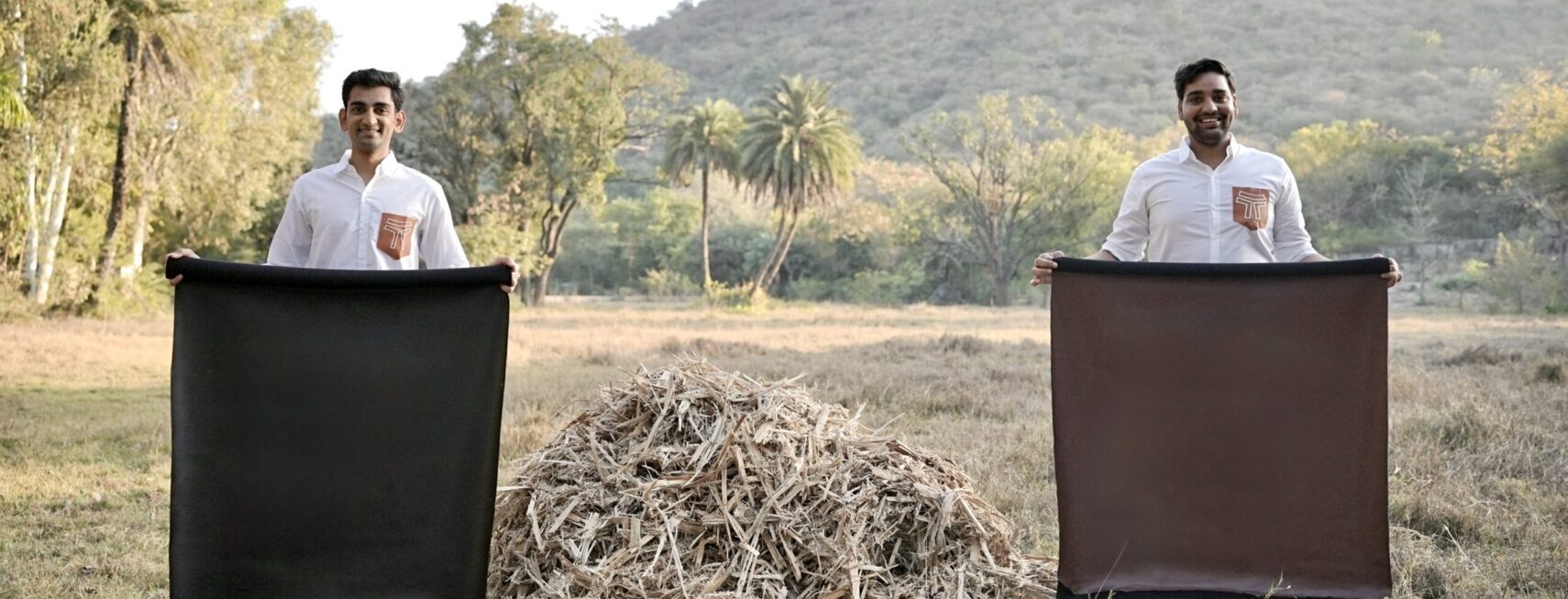
Terratan™ is made from exactly these streams: sugarcane bagasse, wheat husk and rice paddy residue. We refine them into fine microfibres and combine them with proprietary bio-based binders to create a leather alternative made in continuous rolls. It is how we put our motto, “making the best out of waste”, into practice: turning residue that would otherwise be burned into a premium material, while creating additional income for farmers. Read Meet Terratan to learn more.
Work with Terratan
Terratan™ is Bharat Biomaterials’ plant-based leather alternative, made from agricultural residue and produced in continuous rolls in India. Explore the material, read about our sustainability approach, or contact our team to request the technical data sheet and samples.

Sorry, the comment form is closed at this time.